Static analysis
For a component under static or quasi-static load, the resulting stresses and deformations can be calculated using static finite element analysis. The calculated values can then be compared against permissible material properties in order to assess operational safety.
Our engineers can identify any weak points on virtual prototypes as early as the concept or development phase. If weak points are found, they can be optimised promptly and cost-effectively by applying appropriate measures directly in the analysis model.
Depending on the question at hand, the complexity of the models varies — from a first analysis of a simple component without a specific strength verification, right through to the analysis of a complex assembly taking nonlinearities (material, contact, large deformations) and bolt preload into account.
Some of the available analysis options are listed below:
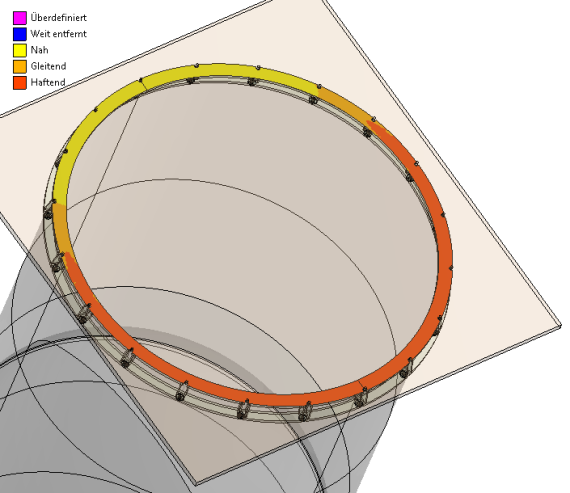
Contact models
To represent the load path within an assembly as realistically as possible, the connection between components is modelled by defining nonlinear contact behaviour. This allows the components to separate from and slide against one another, while preventing them from penetrating each other. Contact can be modelled with or without friction.
Contact models are typically used in the analysis of bolted joints, press fits, seals and form-fit connections.
Material models
Various material models can be used in a finite element analysis. The simplest analysis uses linear-elastic material behaviour, in which stresses are always proportional to the strains that occur. Depending on the requirements, a plastic material model can also be implemented — for alternating loads, this can include the Bauschinger effect.
When analysing plastics, elastomers and foams, appropriate material models are defined, for example hyperelastic or viscoelastic material.

Stability problems (buckling)
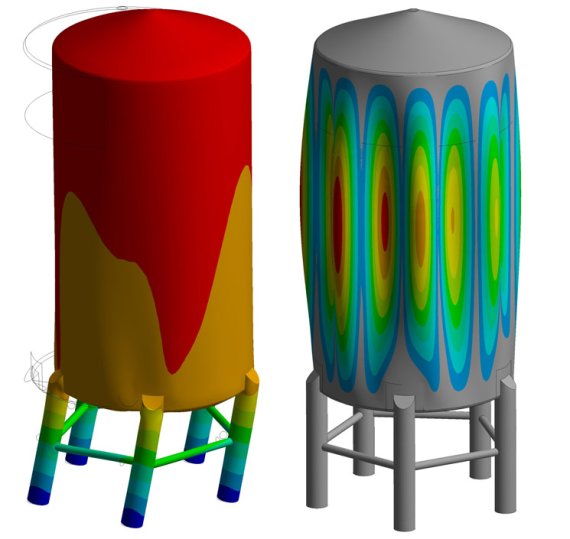
When a structure or its components are loaded in compression, stability problems can arise. At a critical load the structure loses its stability and buckles before the linear-elastic load-bearing capacity is reached. A strength analysis therefore checks not only the stresses that occur, but also the buckling safety.
A linear buckling analysis allows buckling loads to be calculated. A nonlinear buckling analysis can additionally account for nonlinearities such as large deformations, second-order theory, contact and plastic material behaviour. Buckling is strongly influenced by imperfections, which can optionally be imposed on the model and taken into account in the analysis.
Have we caught your interest?
Then get in touch and we will get back to you promptly.
