Pressure-retaining components
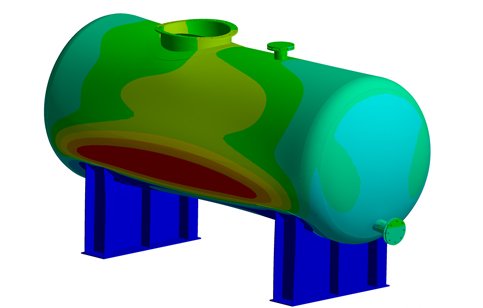
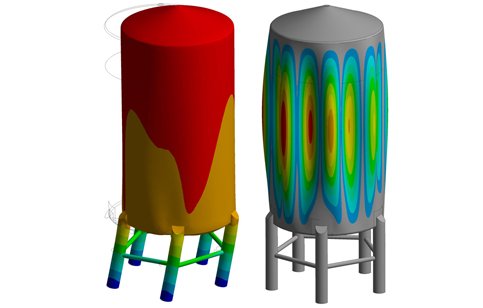
Analysing and sizing pressure-retaining vessels is often not possible analytically, for example in the case of:
- pressure vessels with nozzles or support legs in the knuckle region
- very thick-walled vessels
- nozzles through jacketed vessels
- special shapes or special loads, e.g. seismic spectra or various transients
- the simulation of thermal load cases, e.g. heating or cooling processes
- seismic loads with non-standard supports, e.g. special skirts or lugs
- buckling under vacuum
- sling loads during lifting for assembly or transport
Besides the pressure loads, environmental loads such as snow, wind or seismic loads can also have a relevant influence on the required wall thickness.
Alongside the static verification, a fatigue verification may also be required if the operating loads change frequently.
The verification of a pressure-retaining component normally begins with classifying the vessel under the Pressure Equipment Directive. On the basis of the design pressure, the pressure volume and the medium, this determines whether a vessel must be sized to a harmonised standard or whether it may be designed according to sound engineering practice.
The analysis is usually carried out using finite elements. As a rule one starts with the strength verification of the pressure envelope, followed by the legs and the nozzles. Depending on the applicable code and analysis method, vessels are assessed on the basis of, for example:
- categorisation of the calculated stresses and comparison with permissible values
- plastic strains where a plastic material model is used
- buckling safety factors
- damage in fatigue strength verifications, including for various load cases
- utilisation of connecting elements, e.g. bolts and welds
Codes for the design of pressure-retaining components include, for example:
- EN 13445
- EN 13480
- EN 12516
- EN 14025
- AD 2000
- ASME Section VIII Div. 1
- ASME Section VIII Div. 2
- ASME B31.1
- ASME B31.3
Our analyses are documented in a report suitable for third-party review, in German or English, so that a notified body or your end customer can review and approve it directly.
We also offer our all-inclusive package as an option, in which we not only produce the analysis report but also arrange and manage the design review by a notified body. This removes the effort of managing the review from your side.
Have we caught your interest?
Then get in touch and we will get back to you promptly.
